
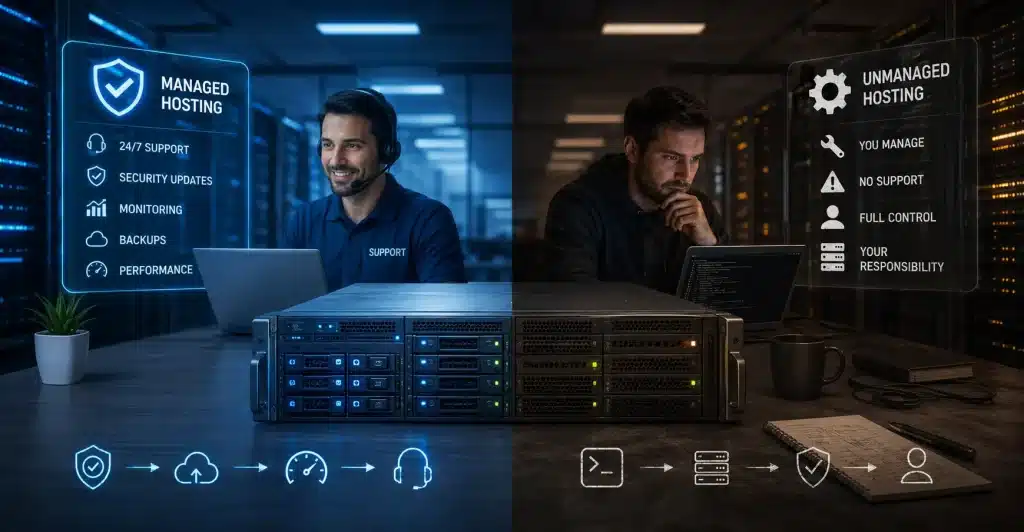
Picking the right server setup is trickier than most people expect, and that’s where the debate around Managed vs Unmanaged Dedicated Server Hosting usually begins. Say you’re launching an online store or scaling a growing app — you’ll quickly face this fork in the road. One path hands your server over to a team of experts who handle everything behind the scenes. The other puts you fully in the driver’s seat, with total control but zero hand-holding. Neither option is wrong; they’re just built for different people. Before you commit, it helps to actually understand what each approach demands from you, your budget, and your team’s technical comfort level.
What Is Managed Dedicated Server Hosting?
Managed dedicated server hosting is a setup where your hosting provider takes care of the technical heavy lifting. You get exclusive use of a physical server, but instead of configuring, securing, and maintaining it yourself, a team of specialists does it for you.
This typically includes:
- Server setup and initial configuration
- Security patching and firewall management
- Performance monitoring and tuning
- Regular backups
- 24/7 technical support
- Software and OS updates
Essentially, you’re paying for expertise and peace of mind alongside the hardware itself.
What Is Unmanaged Dedicated Server Hosting?
Unmanaged dedicated server hosting, on the other hand, gives you the raw server and little else. The provider handles the physical hardware, power, and network connectivity, but everything happening inside the server — the operating system, software installations, security configurations, and troubleshooting — is entirely your responsibility.
It’s the digital equivalent of renting an empty apartment. You get the space, but you’re furnishing, wiring, and maintaining it yourself.
How Managed Dedicated Server Hosting Works
Understanding how managed dedicated server hosting works helps clarify why businesses are willing to pay a premium for it. When you sign up, the provider’s team typically installs your chosen operating system, sets up security protocols, and configures the server according to your application’s needs.
From there, they continuously monitor uptime, apply patches as vulnerabilities are discovered, and step in whenever there’s a performance issue or outage. If your traffic spikes unexpectedly or a plugin causes a conflict, their support team is the one troubleshooting it, not you.
How Unmanaged Dedicated Server Hosting Works
How unmanaged dedicated server hosting works is much simpler on the provider’s end. Once the hardware is delivered and connected to the network, you’re handed root or administrator access and left to configure everything yourself.
This means installing your operating system of choice, setting up your web server software (like Apache or Nginx), configuring firewalls, and monitoring performance manually. Any downtime, misconfiguration, or security breach falls squarely on your team to diagnose and fix.
Benefits of Managed Dedicated Server Hosting
The benefits of managed dedicated server hosting go beyond convenience — they can directly impact your bottom line and reputation:
- Reduced downtime thanks to proactive monitoring and rapid issue resolution
- Stronger security with regular patching and expert-configured firewalls
- Time savings for your internal team, who can focus on core business tasks
- Reliable support available around the clock for emergencies
- Predictable performance through ongoing tuning and optimization
For companies without a dedicated IT department, this model essentially outsources an entire skill set they’d otherwise need to hire for.
Benefits of Unmanaged Dedicated Server Hosting
The benefits of unmanaged dedicated server hosting appeal to a very different audience — one that values control over convenience:
- Lower cost, since you’re not paying for a support team
- Full customization, with no restrictions on software or configurations
- Complete control over every aspect of the server environment
- Flexibility to experiment, test, and build exactly what you need
For developers who enjoy full autonomy, this freedom is often worth the extra effort.
Who Should Use Managed Dedicated Server Hosting?
Wondering who should use managed dedicated server hosting? It’s generally the better fit for:
- Businesses without in-house server administrators
- E-commerce sites that can’t afford downtime
- Companies prioritizing security compliance
- Teams that want to focus on growth, not server maintenance
If your priority is reliability without hiring specialized staff, managed hosting removes that burden entirely.
Who Should Use Unmanaged Dedicated Server Hosting?
On the flip side, who should use unmanaged dedicated server hosting? This option suits:
- Experienced developers and sysadmins
- Startups with tight budgets and strong technical skills
- Businesses needing highly customized server environments
- Agencies managing multiple servers with their own tools
If your team already knows how to configure and secure a server, paying for management services may feel redundant.
Mistakes You Should Avoid
- Underestimating technical requirements when choosing unmanaged hosting
- Assuming “managed” means zero involvement — you still make business decisions
- Ignoring backup verification, regardless of hosting type
- Choosing based on price alone without factoring in downtime risk
- Skipping security audits on unmanaged servers
Key Tips and Recommended Practices
- Evaluate your team’s technical bandwidth honestly before committing.
- Ask providers exactly what “managed” includes — support levels vary widely.
- Test response times with the provider’s support team before signing a long-term contract.
- For unmanaged servers, automate backups and monitoring from day one.
- Revisit your choice annually as your business scales.
Helpful Questions & Answers
1. Which is cheaper, managed or unmanaged hosting?
Unmanaged hosting costs less upfront since you’re not paying for support staff, but you may spend more later fixing issues yourself.
2. Do beginners suit unmanaged dedicated servers?
Not really. Without solid server admin experience, beginners risk security gaps, misconfigurations, and downtime that a managed plan would otherwise prevent entirely.
3. Will managed hosting handle emergency outages?
Yes, most managed providers offer round-the-clock monitoring and rapid response teams, so emergencies get addressed quickly without you lifting a finger.
4. Can I customize a managed dedicated server?
Somewhat. You still get flexibility, but certain configurations may be restricted to keep the server stable, secure, and easier to support.
5. How fast can I set up unmanaged hosting?
Setup speed depends entirely on your skills. Experienced admins configure quickly, while beginners often face a much steeper, slower learning curve.